
2026 SEO Guide: Title Tags, Headings & AI Extraction
Master title tags, H1/H2 hierarchy, meta descriptions, internal anchors, and AI-search extractability with official Google guidance and 2026 research.


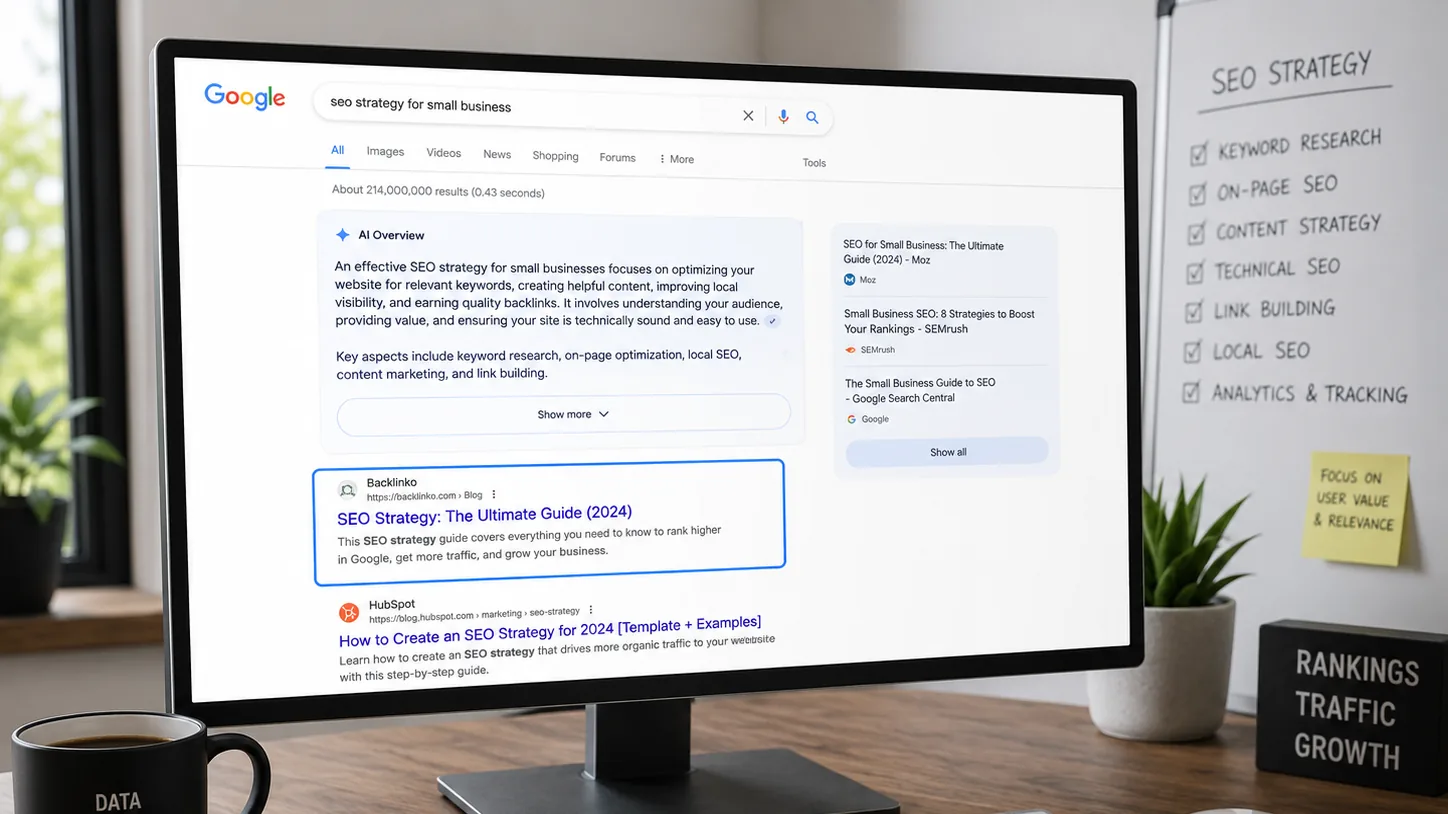
Title tags, heading hierarchy (H1–H6), meta descriptions, snippets and internal anchors remain foundational for search visibility — but in 2026 they must also serve AI-search extractability across AI Overviews, AI Mode and LLM citation engines. Write concise <title> elements that match your H1, structure headings as a clean outline, make the page body itself snippet-ready, and use descriptive internal anchor text. These practices align with Google Search Central guidance, the SEO Starter Guide, and new AI-feature documentation.
- Google builds the title link from six sources — the
<title>is only the first. Align your H1 and on-page anchors so it isn’t rewritten. - Matching H1 to the title tag significantly reduces the odds of Google rewriting your snippet (study of 80,959 URLs).
- Snippet content is now driven by the page body, not the meta description — Google rewrites roughly 70% of meta descriptions.
- Question-style H2s with an immediate answer underneath are the single biggest lever for AI citation.
- Fresh content (updated <30 days) earns a 3.2× citation multiplier across AI platforms.
1Title Tags (Title Links)
Google generates title links from multiple sources: the <title> element, the <h1>, og:title, prominent on-page text, anchor text on the page, and external links pointing to it. The <title> is checked first — but Google may rewrite it if it detects inaccuracies, boilerplate, or a mismatch with the page.
Decision framework: map search intent to title
| Intent type | Title pattern | Example | Key check |
|---|---|---|---|
| Informational | Question or “How to” + context | How to Fix a Leaky Faucet: Step-by-Step Guide | Match H1 exactly |
| Transactional / Ecommerce | Product + key differentiator | Men’s Trail Running Shoes – Waterproof, GORE-TEX | Brand concisely |
| Local | Service + location | Best Plumber in Austin, TX – Emergency Service | No volatile pricing |
| SaaS / Tool | Feature + value proposition | Social Media Scheduler: Automate Posts in Minutes | Lead with the job |
| Programmatic | Template with a distinct variable | 2026 {Model} Review: Price, Specs & Verdict | Must be unique per page |
Why Google rewrites your title link
The most common triggers for a rewrite:
- Inaccurate
<title>— the page visibly says “2026 admissions” but the<title>still says “2020”. Google uses the visible date. - Micro-boilerplate — many pages share a near-identical title (e.g. “Episode – Podcast Name”). Google may inject the season/episode from a heading.
- No clear main title — two headings of equal visual weight; Google picks the first.
- Language mismatch —
<title>in a different language than the body.
Audit your top 100 pages. If the Google rewrite rate is over 40%, align each H1 with its title and make sure the <title> reflects the page’s real main topic.
2H1/H2 Heading Hierarchy & Page Structure
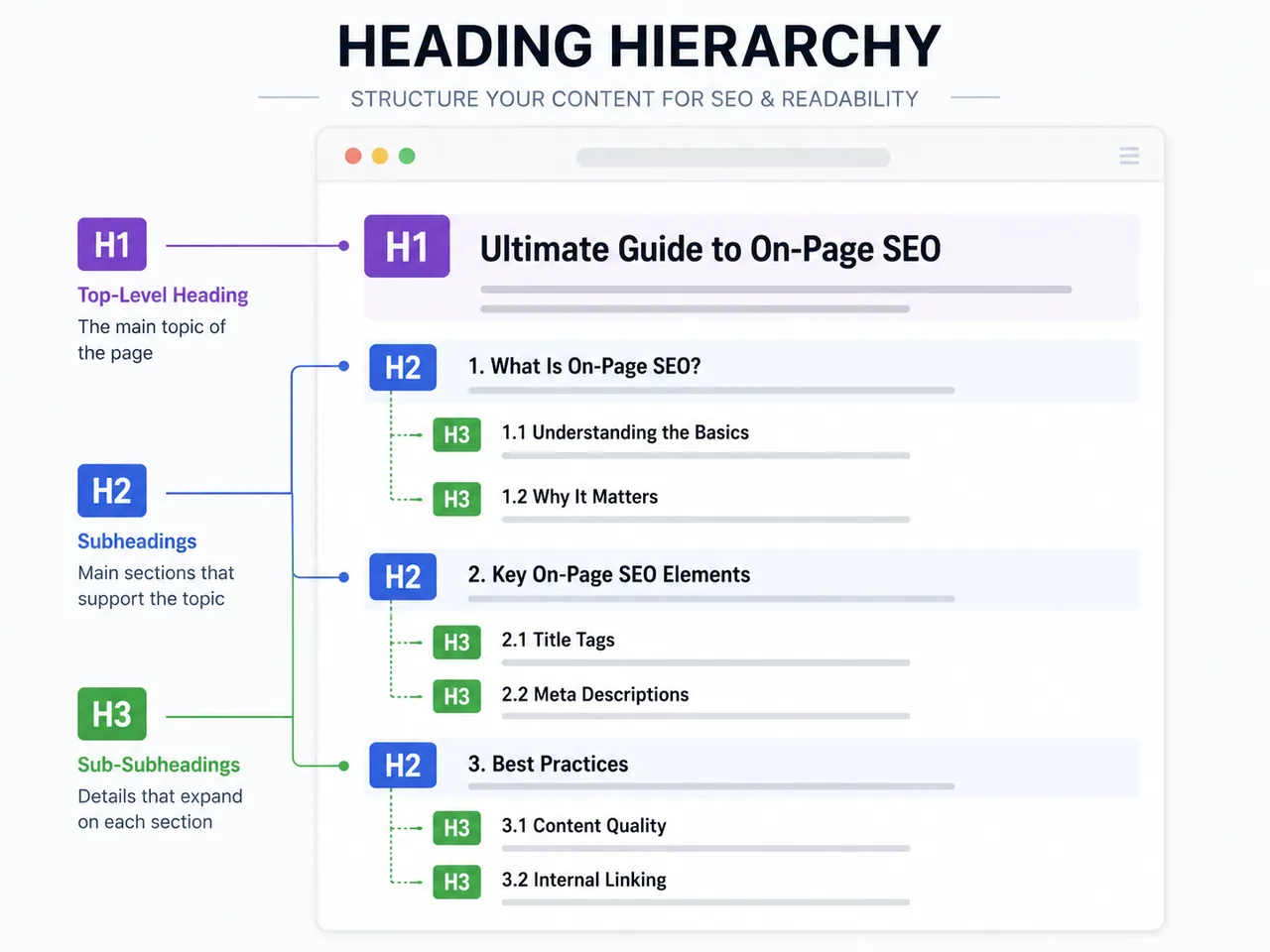
Google uses heading elements both as a source for title links and to understand page structure. The official line: multiple H1s are technically fine (per John Mueller) — but for clarity and AI retrieval, one primary H1 per page is the recommendation.
Think of your headings as the skeleton an AI parser walks before it ever reads a sentence. A clean outline looks like this:
A logical outline (H1 → H2 → H3). The red row shows a skipped level — the kind of gap that confuses both screen readers and AI parsers.
Accessibility pitfalls
Skipping levels — jumping from H1 straight to H3 — breaks the outline for both users and AI parsers. Never choose a heading level for its font size; that’s what CSS is for.
Heading hierarchy for AI passage retrieval
AI models (including Google’s AI Overviews) use heading context to extract relevant passages. Research consistently shows three things:
- Question-style H2s (e.g. “How should heading hierarchy be structured?”) significantly increase the chance of being cited in AI-generated answers.
- An immediate answer after the heading — the first sentence should deliver the core answer to the heading’s implied question.
- The H1 frames the entity — it tells the AI what concept the whole page covers.
Remove every paragraph from your draft and read the headings alone. If they don’t tell the full story on their own, neither your readers nor an AI parser will get it from the prose.
3Meta Descriptions & Snippets
Meta descriptions are not a direct ranking factor, but they influence click-through rate. The catch in 2026:
Featured snippet mechanics
- Featured snippets appear in special boxes where the format of a normal result is reversed.
- Google auto-scrolls to the section containing the snippet — no explicit anchor required.
- To block them, use the
max-snippetrule; to block all snippets, usenosnippet. - AI Overviews and AI Mode require the page to be indexed and snippet-eligible.
Verify structured data with the Rich Results Test · search your target query and note the snippet type (featured, AIO, regular) · use a site: search to see current snippet text · if a competitor holds the box, copy the structure of the heading and sentence directly before their answer.
4Internal Anchors
Anchor text on the page — and the text of links pointing to it — is one of the sources Google uses to build title links. If Google can’t access page content (blocked by robots.txt), it relies on external anchor text alone.
Internal links also help AI models discover related content through query fan-out — Google issues multiple related searches from an AI Overview and often links to several pages from your site.
Best practices for anchor consistency
- Use descriptive, keyword-rich anchor text — never “click here”.
- Make anchor text match the target page’s title or H1.
- Build topical clusters with consistent anchors pointing to authoritative hub pages.
- Keep roughly 2–3 on-page text links per target on average — more dilutes relevance.
5AI-Search Extractability
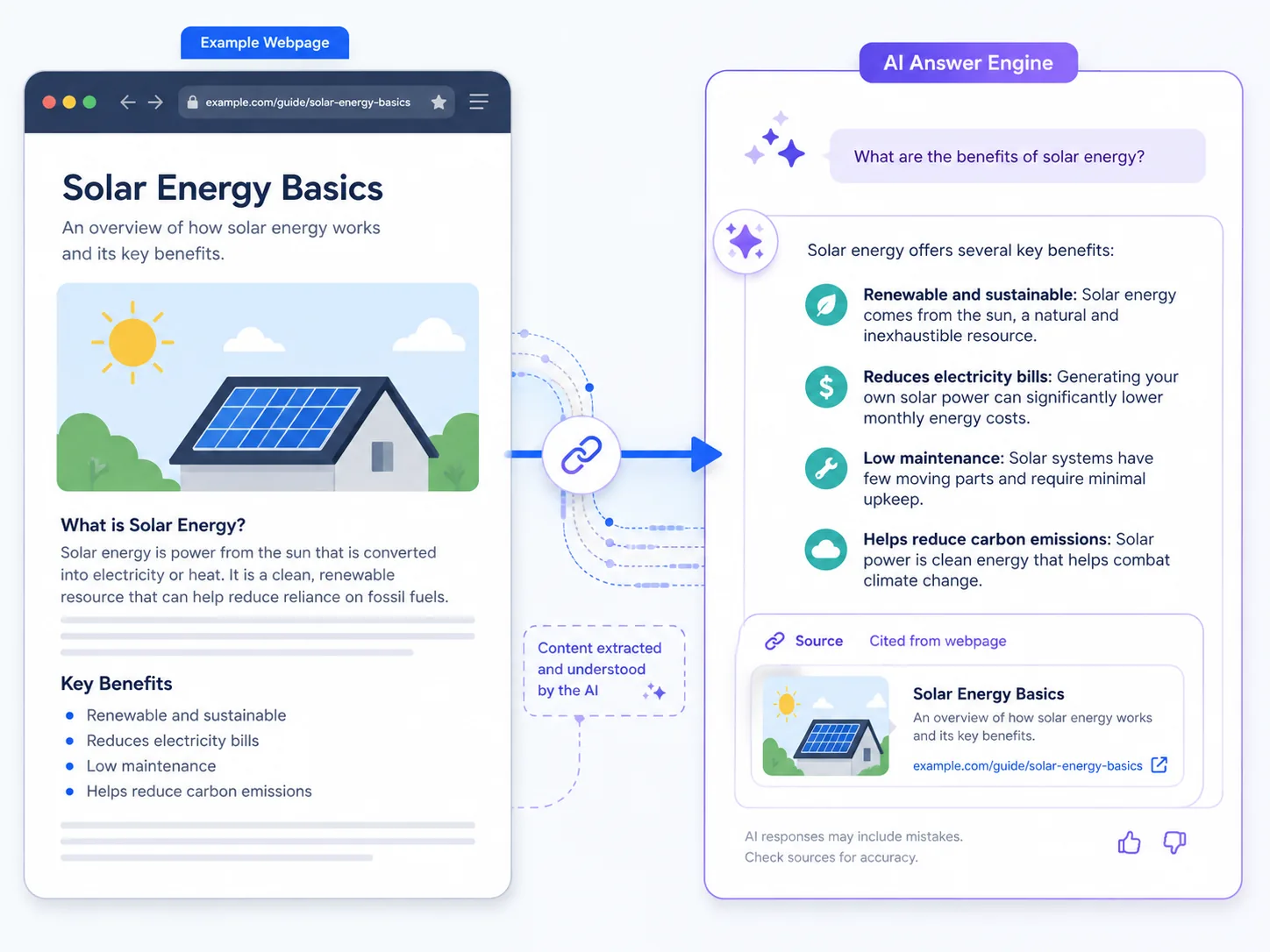
Google’s AI features have no special technical requirement beyond indexing and snippet eligibility. To maximise citations, though, your content has to be optimised for retrieval-augmented generation (RAG). Use the CITABLE framework:
The numbers that matter
Prioritise by business model
- B2B SaaS: ChatGPT — 68% of B2B researchers use it weekly.
- E-commerce: Google AI Mode (shopping features).
- News / Publisher: Perplexity — freshness-driven, 22–35% publisher citations.
- Local: Google AI Mode + Copilot (Bing/Local integration).
6Search Central Title-Link Guidance vs SEO Starter Guide
The two official Google documents don’t contradict each other — but only one explains dynamic title generation. Read both.
| Aspect | Title-Link Guidance | SEO Starter Guide |
|---|---|---|
| Primary source for title | Uses <title> plus headings, anchors, og:title | Recommends a descriptive <title>; assumes it’s used |
| Headings role | Explicitly lists H1 + headings as title sources | Recommends a logical hierarchy |
| Dynamic rewriting | Describes Google injecting missing info (e.g. season no.) | Not discussed |
| Anchor text | Counts on-page + external anchors as sources | Recommends descriptive anchors for usability |
| Branding | Allows omitting the site name if repetitive | Suggests including the site name |
| AI relevance | Multi-source approach mirrors how AI parses pages | Foundations enable extractability |
Relying only on the Starter Guide misses Google’s dynamic title generation and the role of non-<title> sources. Write accurate <title> elements and make sure your headings and anchors tell the same story.
7Practical Audit Checklist
Run this on a sample of 10–20 pages that represent your different content types.
Title tags
- Every page has a
<title>element. <title>is descriptive, concise, and matches the main visible heading.- No micro-boilerplate (e.g. just “| Site Name”).
- Language matches the page content.
- No pricing that changes frequently.
- Brand name included with a separator (pipe, colon, hyphen).
Heading hierarchy
- One primary
<h1>per page, unique across the site. - H1 matches the title tag or conveys the same topic.
- Headings form a logical outline (H1 → H2 → H3, no skipped levels).
- H2s are descriptive and use question form where it fits.
- No heading used purely for styling.
Meta descriptions & snippets
- Meta description exists (130–160 chars) with a call to action.
- The body answers the query concisely in the first paragraph (50–70 words).
- Key content is snippet-eligible (definition box, step, or list).
max-snippet/nosnippetused only intentionally.
Internal anchors & AI extractability
- Body-link anchor text is descriptive and relevant.
- Top linking pages point to core pillars with keyword-rich anchors.
- No orphan pages.
- Visible timestamps present (<30 days old for critical content).
- Content follows the CITABLE framework: BLUF opening, structured sections, third-party validation.
- FAQ + Organization schema applied.
Want this audited for you?
Get a free 30-minute consultation and a custom plan to win both classic search and AI citations.
Frequently Asked Questions
Does matching H1 to the title tag stop Google rewriting my title?
Research on 80,959 URLs found that matching the H1 to the title significantly reduces the probability of a rewrite — but it’s not a guarantee. It’s the single highest-leverage move you can make.
Are multiple H1 tags harmful for SEO?
John Mueller says multiple H1s are fine for Google. For accessibility and AI extraction, though, one primary H1 per page is best practice.
Do I need an llms.txt file for AI Overviews?
No. Google has explicitly stated that llms.txt is not used for Search and will not affect visibility.
How often should I update content to keep AI citations?
Content updated within 30 days earns about 3.2× more citations. After 180 days, Perplexity citation rates can drop from ~82% to ~37%.
Can I opt out of AI Overviews?
There’s no direct opt-out, but you can block snippets via nosnippet, or use the Google-Extended token to limit AI training use.
Back to Top: 2026 SEO Guide: Title Tags, Headings & AI Extraction
For a deeper dive into technical SEO fundamentals, see our comprehensive technical SEO guide.
Originally published in the EcomExperts SEO library · Last reviewed June 2026.