
Ecommerce SEO should be planned from revenue backwards: which product lines can win organic demand, which pages can convert, which technical blockers suppress crawling or rich results, and which content gives buyers enough confidence to choose you.
Most ecommerce SEO plans fail because they count pages, keywords, or articles before they model commercial upside. A better plan starts with the money pages, then builds supporting content and technical fixes around those pages.

The ecommerce SEO ROI model
Use this model before approving a content calendar or technical sprint:
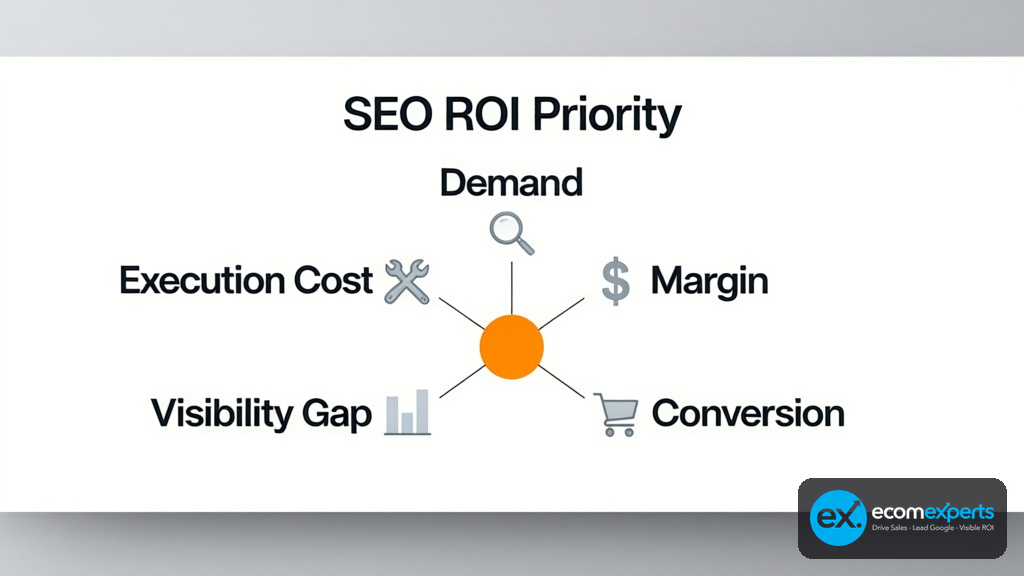
| Input | What to measure | Why it matters |
|---|---|---|
| Demand | Non-brand searches for categories, product attributes, problems, and comparisons | Prevents publishing content nobody is actively searching for |
| Margin | Gross margin by product group | Stops SEO from pushing low-margin traffic that cannot fund acquisition |
| Conversion | Organic conversion rate, assisted conversion, and enquiry quality | Turns ranking estimates into revenue estimates |
| Visibility gap | Current rankings, SERP features, merchant listings, and competitors | Shows where SEO has room to move |
| Execution cost | Content, dev, internal reviews, photography, schema, links | Keeps the plan honest about payback time |
The priority score is not complicated:
Priority = demand x commercial value x ability to win x implementation speed.
If a page has demand and margin but cannot rank because filters create crawl traps, the next action is technical SEO. If a page can rank but lacks useful buying information, the next action is content and merchandising. If Google cannot reliably understand product data, structured data and feed alignment come first.
Start with category pages, not just blog posts
For most ecommerce stores, category and collection pages are the highest-leverage SEO assets. They sit closest to purchase intent and can rank for broad commercial queries, attribute-led queries, and product-type comparisons.
A strong category page usually needs:
- Clear product grouping that matches how buyers search.
- Above-the-fold copy that helps a human choose, without pushing products too far down.
- Useful filters that do not create uncontrolled index bloat.
- Internal links to related categories, buying guides, and high-margin products.
- Unique supporting content based on actual objections, use cases, delivery questions, and compatibility issues.
- Product structured data where appropriate and valid merchant data for eligible product experiences.
Google’s product structured data documentation explains that adding Product markup can help product information appear in richer search experiences such as Google Images and Lens, including price, availability, review ratings, shipping details, and more. See Google’s Product structured data documentation: https://developers.google.com/search/docs/appearance/structured-data/product.
Fix product data before chasing AI search
AI search does not remove the need for clean ecommerce fundamentals. Google’s own guidance for generative AI features says SEO remains relevant because those experiences are rooted in Google’s core Search ranking and quality systems. See Google’s AI optimization guide: https://developers.google.com/search/docs/fundamentals/ai-optimization-guide.
For ecommerce teams, that means the AI-search checklist is still grounded:
- Accurate product titles, descriptions, images, availability, prices, shipping, and returns.
- Consistent product data between the page, structured data, Merchant Center feed, and internal inventory systems.
- Helpful pages that explain use cases, fit, specifications, comparisons, warranty, and post-purchase questions.
- Authoritative brand and business signals: real contact details, policies, reviews, delivery coverage, and support paths.
- Crawlable HTML for the main content and product information.
If a buyer or crawler cannot answer “is this the right product for me?” from the page, an AI system will not magically infer it.
Separate three types of ecommerce content
Do not put every idea into a blog calendar. Ecommerce SEO content should be split by job.
Revenue pages
These are category, collection, product, and landing pages. They should be optimized around purchase intent and internal links from supporting content.
Decision-support content
These are buying guides, comparison pages, size guides, care guides, calculators, and “best for” explainers. Their job is to move buyers into the right revenue page.
Authority content
These are research pieces, case studies, trend analysis, and original data. Their job is to earn links, citations, and brand trust.
An ecommerce blog should publish all three only when each piece has a clear internal linking target and a measurable commercial reason to exist.
The 30-day ecommerce SEO audit sequence
Use this order when you need momentum quickly:
- Map organic revenue by category and product group.
- Pull the top non-brand queries for converting pages from Google Search Console.
- Identify pages with high impressions and weak click-through rate.
- Check whether important category pages are indexable, canonicalized correctly, and internally linked.
- Validate Product, Breadcrumb, Organization, and relevant merchant listing structured data.
- Compare the top three competitors for each money category.
- Rewrite one high-value category page with stronger buying guidance, FAQs, internal links, and structured data fixes.
- Publish one decision-support guide that links back to that category page.
- Track ranking movement, organic conversion, assisted revenue, and crawl/index changes.
This gives you a controlled test before scaling. If the first category cluster does not move, the issue is usually a blocker in technical SEO, search intent, offer competitiveness, or authority.
Common mistakes
- Publishing informational blogs that do not link to revenue pages.
- Creating filter URLs that are indexable without a crawl/indexation strategy.
- Treating Product structured data as a plugin setting instead of a data-quality project.
- Writing generic AI-search content instead of improving product clarity, entity trust, and evidence.
- Reporting keyword wins without revenue, margin, or lead quality.
What EcomExperts measures
For ecommerce SEO, we care about:
- Organic revenue and assisted revenue.
- Non-brand visibility for high-margin categories.
- Product and category page conversion rate.
- Crawl/index health for important page templates.
- Rich result and merchant listing eligibility.
- Search Console query growth around commercial terms.
- Internal linking coverage into money pages.
- Whether the content answers real buyer questions better than competitors.
That is the difference between SEO activity and SEO growth.
Sources
- Google Search Central, Product structured data: https://developers.google.com/search/docs/appearance/structured-data/product
- Google Search Central, Merchant listing structured data: https://developers.google.com/search/docs/appearance/structured-data/merchant-listing
- Google Search Central, Product snippet structured data: https://developers.google.com/search/docs/appearance/structured-data/product-snippet
- Google Search Central, Optimizing for generative AI features: https://developers.google.com/search/docs/fundamentals/ai-optimization-guide